
Back to home
3D Scanning
I need to digitize an existing part
Capture its geometry for documentation, reproduction or redesign.
Process specifications
Working distance
160 to 1400 mm
Optimal distance
400 mm
Maximum field of view
434 x 379 mm
Point distance
0.1 to 3 mm
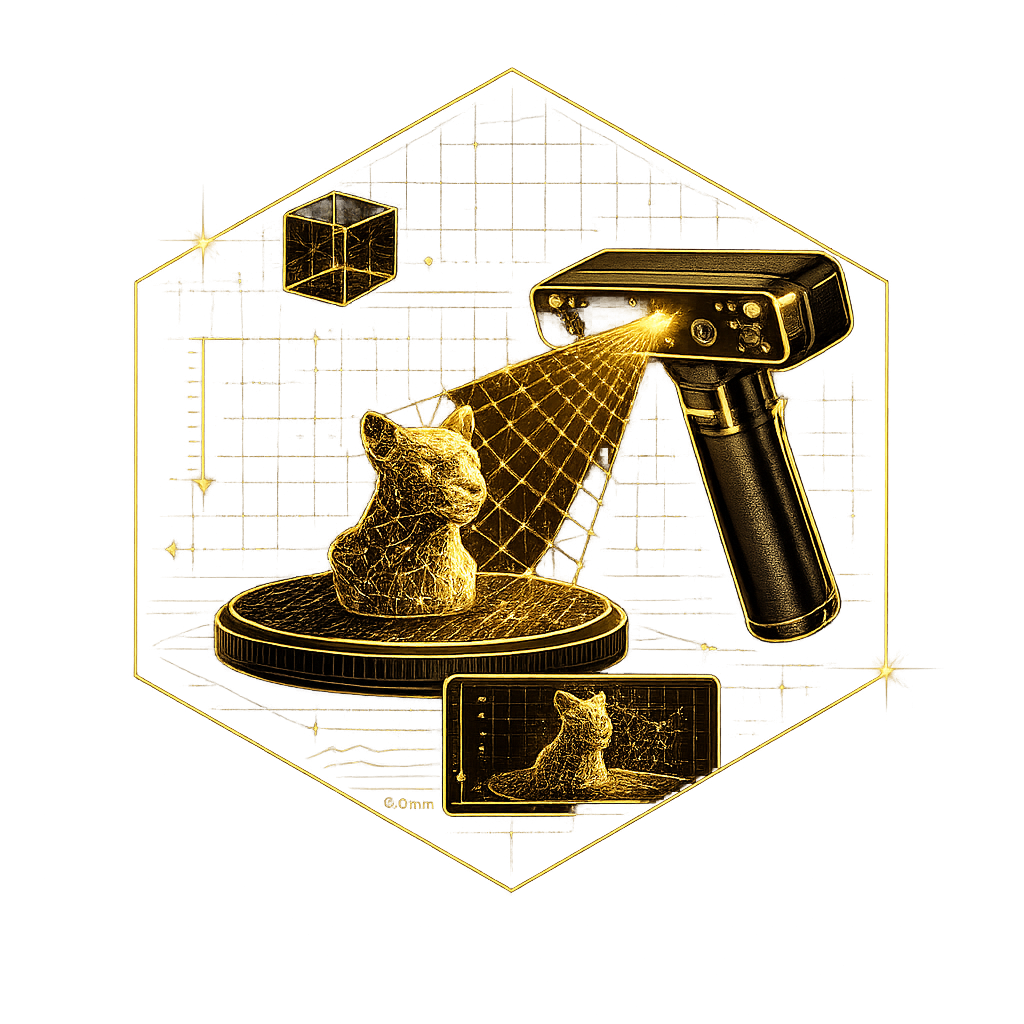
- SHINING 3D Einstar handheld structured-light scanner for capturing real parts.
- Point distance: 0.1 to 3 mm depending on setup and working distance.
- Working distance: 160 to 1400 mm; optimal distance is around 400 mm.
- Maximum field of view: 434 x 379 mm at the optimal distance.
Materials
- Physical parts
- Assemblies
- Reference geometries
Technical process details
The process captures real geometry to produce meshes, dimensional references, and a base for redesign or reproduction.
It works best when the goal is to document, replicate, or adapt an existing part before fabricating again.
Reflective, transparent, or occluded surfaces usually require additional preparation and geometry cleanup afterward.
Typical outcomes
- Meshes
- Reference captures
- Base geometry for redesign
What you can request
- Scanning physical parts, objects, CAD design references, reproduction, or adaptation projects.
- Models for 3D printing, catalog, rendering, visual inspection, or reverse engineering.
- Digitizing existing parts when there are no reliable drawings or 3D files.
What we need to quote
- Physical object, photos, and reference dimensions.
- File use: mesh only, 3D printing, CAD redesign, inspection, or rendering.
- Expected precision level and desired format: STL, OBJ, STEP, or another format.
Important limitations
- Scanning does not automatically create editable CAD; reverse engineering is quoted separately.
- Transparent, black, glossy, or highly reflective surfaces may require preparation.
- Hidden areas, deep internal features, or very small parts can require additional capture work.
Let’s discuss your project
Tell us what you need to solve.
You do not need to know the process or have a file ready. Share your idea, intended use and target date; we will review the right approach with you.
Prefer a conversation, or need to share files and photos?
Talk on WhatsAppFrequently asked questions
Answers before starting your project
Find answers about quotes, files, manufacturing and courses. You can search or choose a topic.
Quotes, payments and delivery
Which file formats do you accept: STL, 3MF, STEP, DXF or SVG?
For 3D printing we review STL, STEP, 3MF and OBJ files. For laser work you can share DXF, SVG, PDF, AI or a reference image; for CNC, DXF, STEP, SVG or a dimensioned drawing. The format and any necessary adjustments are reviewed for the process: an image or reference does not automatically replace a manufacturing-ready file.
Are design and file corrections charged separately?
The scope of design, modeling and file preparation is defined in the quote. Corrections to customer files, new versions and changes after approval may be quoted separately and require authorization before additional work is carried out. CAD service does include tolerance adjustments; design changes are not included.
Quotation terms3D printing, materials and finishes
What accuracy and tolerances can I expect?
Tolerances are defined for each project and depend on the process settings. In FDM 3D printing, they can vary with layer height and nozzle size, among other factors. Share your part’s critical dimensions and fit requirements so tolerances can be reviewed before manufacturing is confirmed.
Design, scanning and files
Can you reproduce a replacement from a broken part?
We can review a physical part, photographs and measurements to assess reproduction through scanning, CAD design or reverse engineering before manufacturing. A broken part may require reconstructing geometry and confirming dimensions and operating conditions; feasibility and scope are reviewed before quoting.
Does 3D scanning include an editable CAD model, or is that quoted separately?
Scanning does not automatically produce editable CAD. The scan produces a mesh or geometry reference; reconstructing an editable model through reverse engineering is quoted separately. Specify whether you need a mesh, a print file, a model for redesign or a particular format so the deliverable can be defined.
Can I request editable files or source code?
Yes, you can request editable files, source code and other project deliverables. Each requested deliverable has an additional cost and is quoted separately. Specify which ones you need when requesting a quote so they can be covered in the scope.
Can you enter into a confidentiality agreement?
Yes, we can enter into confidentiality agreements when needed. If your project requires one, mention it when contacting us so its terms can be agreed.
Need help with your project? Contact Nectar.
Contact
Let's talk about your project.
Location: Leon, Guanajuato, Mexico
Service area: Leon, Guanajuato and projects across Mexico
Email: contacto@nectartech.com.mx
Phone / WhatsApp: +52 1 477 271 8568
Instagram: instagram.com/nectartechmx